Choosing Perforated Gutter Guard Width for Common Gutter Profiles
Choosing Perforated Gutter Guard Width for Common Gutter Profiles
Introduction
Choosing perforated gutter guard width for common gutter profiles is the single most important decision you will make when protecting your home’s drainage system. Get it wrong, and you will be back on the ladder within a season, scraping out pine needles and fighting wasp nests. Get it right, and the system works quietly for years.
Most homeowners assume wider is better. That assumption fails because gutter guards must sit flush against the gutter’s internal walls. A guard that is too narrow leaves a gap where debris sneaks through. One that is too wide buckles, creating a crown that diverts rainwater over the edge instead of into the downpipe. The industry standard for residential gutters in North America and Australia is a 5-inch (127 mm) profile, but 6-inch (152 mm) and 4-inch (102 mm) profiles are common in commercial and older builds.
This guide walks you through measuring your existing gutter profile, matching it to the correct perforated guard width, and installing it so the mesh sits flat. We cover the four most common gutter profiles, the tolerances you need to respect, and the mistakes that ruin otherwise good installations. By the end, you will know exactly which width to order and how to verify it before you climb the ladder. Relevant specifications and application guidance are available through DVA Mesh.
Key Takeaways
- Measure the gutter’s top opening width, not the outer lip, to determine the correct guard size.
- Standard residential gutters use a 5-inch profile; the guard should be 1/4 to 1/2 inch narrower than the opening.
- Perforated aluminium mesh with 1/16-inch to 1/8-inch openings blocks most leaf debris while allowing water flow.
- Expansion and contraction of aluminium mean you need a small gap at each end of the guard run.
- Verify the supplier’s actual mesh dimensions against your measurements before placing a bulk order.
What You Need Before Starting
Before you measure anything, gather these tools:
- A steel tape measure (not a cloth one — it stretches)
- A notepad or phone for recording dimensions
- A ladder with a stabilizer bar, or better, a second person to hold it
- A straightedge or carpenter’s square
- A digital caliper if you want to check mesh opening sizes precisely
You also need to know your gutter material. Aluminium gutters expand and contract with temperature changes far more than steel. A guard that fits perfectly on a 20°C day may bind on a 40°C afternoon. This matters because the guard must float slightly within the gutter channel, not lock in place.
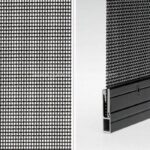
The product you will likely be working with is Aluminium Gutter Mesh, which is an expanded protective mesh designed to sit over the gutter opening and create a barrier against leaves and debris. It comes in sheets or rolls, and the width you choose determines how well it seats in the channel.
Step 1 — Identify Your Gutter Profile Type
What to Do
Walk the perimeter of your property and look at the gutter cross-section from the end. You are identifying the shape, not measuring yet. The four common profiles are:
- K-style (ogee) — The most common residential profile in North America. It has a flat back, a decorative front with a curve, and a flat bottom. The top opening is roughly the same width as the nominal size.
- Half-round — A semicircular channel, common on older homes and some high-end builds. The top opening is the diameter of the half-circle.
- Box (rectangular) — A straight-sided channel with a flat bottom, common on commercial buildings and modern flat-roof designs.
- Fascia — A shallow channel that mounts directly to the fascia board, often with a visible front lip. These are usually narrower than K-style.
Write down which profile you have for each gutter run. A single house can have two different profiles if an addition was built later. Do not assume uniformity.
Why This Matters
The profile determines how the guard seats. A K-style gutter has a flat bottom, so a rigid expanded mesh guard sits flat across the opening. A half-round gutter has a curved bottom, so the guard must either flex to follow the curve or be installed with a slight bow. Box gutters are the easiest — the guard drops in and sits on internal ledges.
The profile also affects the effective width. A 5-inch K-style gutter has a top opening of about 4.5 inches because the front lip angles inward. A 5-inch half-round gutter has a true 5-inch opening. If you order based on the nominal size without measuring the actual opening, you will end up with a guard that is too wide for the K-style.
Common Mistakes to Avoid
- Assuming the nominal size equals the opening width: It rarely does. Always measure the actual top opening.
- Mixing profiles on one order: If your house has both K-style and half-round gutters, you need two different guard widths. Order them separately.
- Ignoring gutter depth: A shallow fascia gutter may not have enough depth to hold a rigid guard. You may need a flexible or roll-type mesh instead.
Step 2 — Measure the Top Opening Width Accurately
What to Do
For each gutter run, take three measurements of the top opening:
- At the downpipe end — where debris tends to accumulate
- At the midpoint of the run
- At the far end — away from the downpipe
Use the steel tape measure and record the inside width from the back wall to the inside of the front lip. Do not measure the outer edges of the gutter — that includes the thickness of the material and will give you a number that is too large.
Take the smallest of the three measurements as your reference. Gutters sag and bow over time, and the narrowest point is where a too-wide guard will bind.
Why This Matters
The guard must sit inside the channel, not on top of the edges. If the guard is wider than the narrowest point, it will not drop in. If it is narrower than the widest point by more than half an inch, it will rattle and let debris pass through the gap.
For a standard 5-inch K-style gutter, the actual top opening is typically 4.25 to 4.5 inches. A guard width of 4 inches works well. For a 6-inch K-style, the opening is about 5.25 to 5.5 inches, and a 5-inch guard is appropriate. Half-round gutters are more forgiving — a 5-inch guard fits a 5-inch half-round with about 1/8 inch of play on each side.
Common Mistakes to Avoid
- Measuring once and ordering: Gutters are not perfectly straight. Measure at least three points per run.
- Using a cloth tape: It stretches and gives you a false reading. Use steel.
- Forgetting the front lip: The inward-curving lip of a K-style gutter reduces the effective opening. Measure inside the lip, not over it.
Step 3 — Match Guard Width to Gutter Profile
What to Do
Use the table below as a starting point. These are typical values for common profiles, but always verify against your own measurements.
Gutter Profile
Nominal Size
Typical Top Opening
Recommended Guard Width
K-style
5 inch (127 mm)
4.25–4.5 in (108–114 mm)
4 in (102 mm)
K-style
6 inch (152 mm)
5.25–5.5 in (133–140 mm)
5 in (127 mm)
Half-round
5 inch (127 mm)
5.0 in (127 mm)
4.75–5 in (121–127 mm)
Half-round
6 inch (152 mm)
6.0 in (152 mm)
5.75–6 in (146–152 mm)
Box
4 inch (102 mm)
3.75–4.0 in (95–102 mm)
3.5 in (89 mm)
Box
5 inch (127 mm)
4.75–5.0 in (121–127 mm)
4.5 in (114 mm)
The general rule: the guard should be 1/4 to 1/2 inch narrower than the smallest measured opening. This leaves room for thermal expansion and for the clips or screws that hold the guard in place.
Why This Matters
A guard that is too wide will not seat properly. It will sit proud of the gutter, and rainwater will sheet over the front edge instead of entering the channel. A guard that is too narrow leaves a gap at the back wall where fine debris and roof grit accumulate. Over a season, that gap fills and becomes a seed bed for weeds.
The mesh opening size matters as much as the overall width. Perforated aluminium mesh with openings between 1/16 inch (1.6 mm) and 1/8 inch (3.2 mm) blocks most leaf debris while allowing adequate water flow. Larger openings, up to 1/4 inch (6.4 mm), pass more water but let in pine needles and small twigs. For areas with heavy pine needle drop, choose the smaller opening.
Common Mistakes to Avoid
- Ordering the nominal size: A 5-inch gutter needs a 4-inch guard, not a 5-inch guard. The nominal size refers to the gutter, not the guard.
- Ignoring thermal expansion: Aluminium expands about 0.000012 inches per inch per degree Fahrenheit. On a 30-foot run, that is about 0.13 inches of movement between winter and summer. The guard needs room to move.
- Choosing a guard with openings too large for your debris type: Match the mesh opening to what falls on your roof, not to what looks good.
Step 4 — Verify the Supplier’s Dimensions Before Ordering
What to Do
Before you place an order, confirm the actual dimensions of the mesh you are buying. Ask the supplier for:
- The nominal width — what they call the product
- The actual width — what you will receive, measured edge to edge
- The mesh opening size — the dimensions of the perforations or diamond openings
- The sheet or roll length — so you can calculate how many pieces you need
For expanded metal mesh, the diamond opening size is measured as the long way (LWO) and short way (SWO) of the diamond. These dimensions determine how much debris passes through and how much water flows. A typical aluminium gutter mesh has a diamond opening of about 1/8 inch by 3/16 inch (3.2 mm by 4.8 mm), which balances debris blocking with water flow.
The same expanded metal process used for gutter mesh is also applied in other industries. For example, Aquaculture & poultry farming uses similar expanded aluminium mesh for enclosures and filtration, where consistent opening sizes are critical for animal safety. The manufacturing tolerances matter in both applications.
Why This Matters
Suppliers list nominal dimensions that may differ from actual dimensions by several percent. For a 4-inch guard, a 5% variance is only 0.2 inches — not a problem. But for a 6-inch guard on a tight half-round gutter, that same variance can mean the difference between a flush fit and a buckled mess.
Expanded metal also has a specific pattern direction. The diamonds run at an angle to the sheet edges. When you cut the mesh to length, the cut edges may have sharp points or irregular openings. Ask the supplier whether the edges are flattened or if you need to handle them yourself.
Common Mistakes to Avoid
- Trusting the catalog photo: Request a sample or the actual dimension sheet before ordering in bulk.
- Not accounting for cutting waste: If you need 20 pieces at 4 feet each, order extra to cover the diamond pattern offset at the cut lines.
- Ignoring the edge condition: Unflattened expanded metal edges are sharp and can cut through gutter sealant or scratch the gutter paint.
Step 5 — Install with the Correct Fastening Method
What to Do
Installation methods vary by profile, but the principles are the same:
- Cut the mesh to length using tin snips or an angle grinder with a thin cutting disc. Cut slightly long — you can trim, but you cannot add.
- Drop the guard into the channel so it sits on the bottom or on the internal ledges. It should not rest on the front lip alone.
- Secure the guard with gutter guard clips or stainless steel screws. For K-style gutters, clips that hook over the front lip and back wall work best. For half-round, screws through the mesh into the gutter wall at 24-inch (610 mm) intervals are typical.
- Leave a 1/8-inch (3.2 mm) gap at each end of the run for thermal expansion. Do not butt the pieces tightly together.
If you are working with a flexible or roll-type mesh, unroll it along the gutter and let it settle into the channel before fastening. The mesh should follow the curve of a half-round gutter without forcing it flat.
Why This Matters
The fastening method determines whether the guard stays put in a storm. A guard that is only laid in place will lift in high winds or when heavy debris accumulates on top. Screws and clips add a mechanical connection that keeps the mesh seated.
The expansion gap is not optional. Aluminium gutter mesh and aluminium gutters have the same coefficient of thermal expansion, but the guard is often installed at a different temperature than the gutter. If you install in summer and the guard is tight, it will buckle in winter when both contract. The gap absorbs that movement.
Common Mistakes to Avoid
- Screwing the mesh down tight: The mesh needs to float. Use screws with a washer and do not over-torque.
- Installing in direct sunlight: The mesh will be warmer than the gutter and will contract more when it cools. Install in the morning or evening for a more neutral fit.
- Forgetting the downpipe strainer: The guard keeps debris out of the gutter, but a strainer at the downpipe entrance catches what does get through. Install both.
Pro Tips for Success
- Buy a sample piece first: Order a 1-foot length of the mesh you plan to use and test it in your gutter before committing to a full order. The cost is minimal compared to a wrong bulk purchase.
- Check the mesh opening against your worst debris: If you have oak trees, test with an acorn. If you have pine, test with a handful of needles. The mesh should block them while still passing a visible stream of water.
- Consider the color: Powder-coated or painted aluminium mesh blends with the gutter and is less visible from the ground. Bare aluminium will oxidize to a dull gray over time.
- For security-conscious installations, the same expanded aluminium mesh used for gutters also works as a one-way vision screen. DVA Mesh provides security while limiting visibility from outside, which is useful if you are also screening windows or vents on the same property.
Frequently Asked Questions
What is the standard width for a 5-inch K-style gutter guard?
A 5-inch K-style gutter has a top opening of about 4.25 to 4.5 inches. The guard should be 4 inches wide. This leaves a 1/4-inch gap on each side for thermal expansion and allows the guard to drop into the channel without binding against the front lip.
Can I use the same guard width for half-round and K-style gutters?
No. Half-round gutters have a true opening equal to their nominal size, while K-style gutters have a reduced opening due to the inward-curving front lip. A 5-inch guard for a half-round gutter will be too wide for a 5-inch K-style. Measure each profile separately.
How do I measure the gutter opening without climbing a ladder?
Use a telescoping measuring pole with a tape measure attachment, or take a photo with a reference object (like a ruler) placed across the gutter opening. For accuracy, you still need to measure at multiple points along the run, which usually requires a ladder.
What mesh opening size blocks pine needles?
Pine needles are typically 3 to 6 inches long but only 1/16 to 1/8 inch wide. They slide through larger openings lengthwise. A mesh opening of 1/16 inch (1.6 mm) or smaller blocks most pine needles. Openings of 1/8 inch (3.2 mm) will let some needles through.
How much expansion gap should I leave between guard sections?
Leave 1/8 inch (3.2 mm) between sections and at each end of the run. Aluminium expands about 0.000012 inches per inch per degree Fahrenheit. On a 30-foot run, that is roughly 0.13 inches of total movement between summer and winter temperatures.
Conclusion
Choosing perforated gutter guard width for common gutter profiles comes down to measuring the actual opening, not trusting the nominal size, and leaving room for the mesh to move. The four common profiles — K-style, half-round, box, and fascia — each have different opening dimensions, and a guard that fits one will not fit another.
The process is straightforward: identify the profile, measure the top opening at three points per run, subtract 1/4 to 1/2 inch for clearance, and verify the supplier’s actual dimensions before ordering. Match the mesh opening size to the debris you actually deal with, and install with clips or screws that allow thermal movement.
Start by measuring one gutter run today. Write down the numbers, compare them to the table in this guide, and order a sample piece before committing to a full purchase. That single sample will tell you more than any catalog specification about whether the guard seats properly in your gutters. When it fits flush, stays flat, and passes water without passing debris, you have the right width.