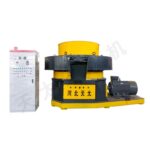
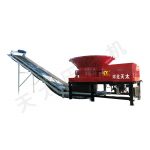
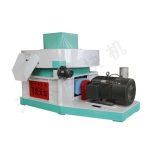
Flat Die Pellet Machine
For a farm processing its own sawdust, a cooperative producing livestock feed, or a small biomass fuel enterprise running 4–8 hours a day, that scale is both unnecessary and uneconomical.Flat Die Pellet Machine is built around a different logic: a fixed flat die and rotating compression rollers that press material vertically downward through die holes. The result is a machine that handles 300 to 1,500 kg/h, can be operated and maintained by a single person without specialist training.Six models from 30kW to 132kW. Processes sawdust, wood chips, rice husk, straw, alfalfa, corn stalks, and animal feed ingredients. CE certified.
How the Wood Pellet Machine Works
Rotating roller + fixed flat die — the core mechanism
Material fed from the top hopper falls onto a horizontal flat die — a thick steel disc drilled with hundreds of cylindrical holes (pellet diameter). Two or three hardened steel press rollers rotate across the die surface, forcing material downward through the holes under high pressure. The extruded cylinders are cut to uniform length by an adjustable knife below the die, producing finished pellets that fall into the discharge chute.
This vertical compression path gives the flat die mill three practical advantages over belt-fed or screw-fed designs:
① Self-cleaning feed pathBecause material moves downward by gravity through the die, there are no horizontal feed channels to clog with fibrous or sticky inputs (alfalfa, green straw, wet animal feed mix). This is the primary reason flat die mills handle a wider variety of raw materials than ring die mills at comparable power ratings.
② Fast die and roller changeoverDie removal requires unbolting the retaining ring and lifting the die plate — a task one person completes in 20–30 minutes with standard tools. This enables quick material switches (e.g., running sawdust pellets in the morning and animal feed in the afternoon on the same machine) without full disassembly.
More information please contact Tiantai