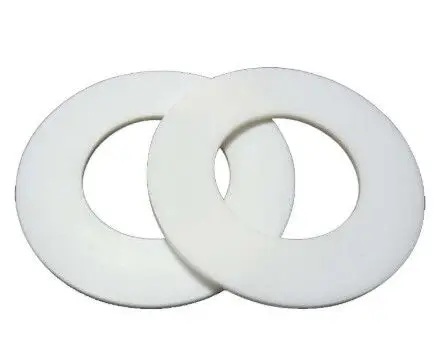
PTFE Gaskets vs. Rubber Gaskets: Performance & Applications
PTFE and Rubber Gaskets: Choosing the Right Sealing Material for Industrial Applications
In industrial production, sealing technology is a crucial element in ensuring the safe operation of equipment and the efficiency of production. Gaskets, as an essential part of the sealing system, play a vital role in the success or failure of the sealing effect. This article focuses on two common types of gasket materials: PTFE gaskets and rubber gaskets, providing a detailed analysis of their performance characteristics, application scenarios, and usage precautions to help readers better understand and select the appropriate gasket material.
PTFE Gaskets: Corrosion-Resistant Sealing Solution
PTFE gaskets stand out for their exceptional corrosion resistance, making them the first choice for many engineers and technicians. Their stable performance in harsh environments such as strong acids and alkalis makes them reliable for handling complex chemical media.
1. Material Characteristics
PTFE gaskets are primarily made from polytetrafluoroethylene (PTFE), a material capable of maintaining stability in highly corrosive media such as strong acids, alkalis, and halogens. It is nearly insoluble in any solvent at room temperature. However, PTFE is prone to cold flow and creep under pressure and high temperatures, so PTFE gaskets are typically suitable for low-pressure, moderate-temperature environments (generally below 150°C and 1 MPa).
2. Performance Characteristics
-
Cold Flow and Creep: PTFE exhibits creep under high temperature and pressure, reducing sealing pressure over time. Filled PTFE materials can improve strength but may slightly reduce corrosion resistance.
-
Coefficient of Friction: Low (0.035–0.04), making PTFE gaskets prone to slipping; raised-face flanges or contact with bolts can mitigate this.
-
Corrosion Resistance: Resistant to almost all strong acids, strong oxidizing agents, reducing agents, and organic solvents (except molten alkali metals, fluorinated media, and sodium hydroxide above 300°C).
3. Application Scenarios
-
Pharmaceutical industry: Prevents contamination in drug production.
-
Petrochemical industry: Handles strong acids and alkalis safely.
-
Pumps: Suitable for diaphragm and metering pumps dealing with complex chemical media.
4. Usage Precautions
-
Temperature and Pressure Control: Keep below 150°C and 1 MPa.
-
Flange Design: Use raised-face flanges or ensure gasket contact with bolts to prevent slippage.
-
Stress Relaxation: Increase pre-tightening force during installation but stay within material limits.
Rubber Gaskets: Soft & Reliable Sealing Option
Rubber gaskets are valued for flexibility and excellent sealing performance. They can adapt to various media and achieve reliable sealing with relatively low pre-tightening forces, especially in low-pressure and vacuum environments.
1. Material Characteristics
Rubber gaskets are made from natural or synthetic rubber. Their flexibility and conformability enable good sealing performance with lower pre-tightening forces.
2. Performance Characteristics
-
Natural Rubber: Water, seawater, air, inert gases, alkalis; operating temperature ≤ 90°C, low-temperature use down to -60°C.
-
Nitrile Rubber: Petroleum products; long-term temperature ≤ 120°C, short-term ≤ 150°C, low-temperature -10°C to -20°C.
-
Neoprene Rubber: Weak acids, weak alkalis, seawater; long-term temperature ≤ 90°C, max 130°C, low-temperature -30°C to -50°C.
-
Fluororubber: Acids, oxidation, oils, solvents; long-term temperature ≤ 200°C.
3. Application Scenarios
Rubber gaskets are suitable for padding, sealing, and cushioning in low-pressure and vacuum systems across industries such as pharmaceuticals, electronics, chemicals, and food processing.
4. Usage Precautions
-
Media Compatibility: Select rubber type based on the medium.
-
Temperature Control: Follow material-specific operating limits.
-
Pre-tightening Force Control: Avoid excessive force to prevent deformation.
Performance Comparison: PTFE vs Rubber GasketsPerformance IndicatorPTFE GasketsRubber GasketsCorrosion ResistanceExtremely strong, resistant to most acids and alkalisVaries by rubber typeFlexibilityPoor, prone to creep and cold flowGood, excellent conformabilityTemperature Range-100°C to 150°CNarrower, varies by rubber typePressure RangeBelow 1 MPaLow pressure (<0.6 MPa)Coefficient of FrictionLow, prone to slippingHigher, less prone to slippingStress RelaxationSignificantMildConclusion
PTFE and rubber gaskets are both commonly used sealing materials in industrial production, each with unique strengths. PTFE gaskets excel in corrosion resistance and contamination prevention, while rubber gaskets offer flexibility, conformability, and reliable sealing under low-pressure conditions. Selecting the appropriate gasket requires careful consideration of working conditions, media type, temperature, and pressure to ensure safe and efficient operation.
By understanding these characteristics, engineers and technicians can choose the right gasket material, ensuring reliability, safety, and efficiency in industrial production.
It’s important to know about Google SEO to help your website rank higher in search results.


