
Why Startups Choose a White Label Gojek Clone Over Custom Development
Launching an on demand marketplace starts with one important decision: build from scratch or launch with a ready-made solution. For many startups, that choice affects how quickly they can enter the market, how much they spend, and how much risk they take on before they even get their first customers.
This article looks at the difference between a White Label Gojek Clone and Custom Gojek App Development, and why each option fits a different stage of growth. While both can support a successful business, understanding their trade-offs can help founders choose the path that best matches their goals, budget, and long-term plans.
What Is a White Label Gojek Clone?A ready-made foundation for a multi-service business
A White-Label Gojek Clone is a ready-made multi-service platform that businesses can customize with their own branding, colors, logo, and business rules before launching it as their own product.
Rather than spending months or years building every feature from the ground up, startups receive a working foundation that already includes the essential components of an on demand marketplace.
Most solutions typically include:
-
Customer application
-
Service provider application
-
Delivery partner application
-
Admin dashboard
-
Payment gateway integration
-
Push notifications
-
GPS tracking
-
Booking management
-
Order history
-
Ratings and reviews
-
Promotional tools
-
Business analytics
The result is a platform that can be tailored to fit a company’s identity without rebuilding the underlying technology.
Why the white label model appeals to startups
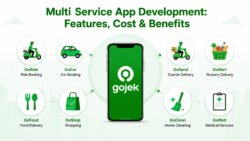
A modern White Label Super App often supports multiple business categories within one ecosystem. Instead of offering only ride hailing or only food delivery, founders can combine services such as grocery delivery, courier services, home maintenance, beauty appointments, pharmacy delivery, laundry, and many others into a single application.
That flexibility matters because many startups do not begin with a fully formed super app strategy. They start with one service category, test demand, and expand from there. A white label model gives them room to do that without starting over each time they add a new vertical.
What Does Custom Gojek App Development Involve?Building from a blank canvas
Custom Gojek App Development starts with a blank canvas.
Instead of adapting an existing platform, a development team designs every feature specifically for the business. This includes planning the product architecture, creating user experiences, writing backend systems, building mobile applications, integrating third party services, testing, deployment, and ongoing maintenance.
This process gives companies complete flexibility.
If a startup wants a unique booking workflow, proprietary matching algorithm, industry specific automation, or entirely new marketplace concept, custom development makes those ideas possible.
The tradeoff behind full customization
The tradeoff is that building software from scratch requires considerably more planning, engineering resources, testing cycles, and financial investment before the first customer can even use the product.
For startups with limited budgets or uncertain market demand, that can introduce additional business risk.
Custom development can be the right choice, but it usually makes more sense when the business already knows exactly what it needs and has the resources to support a longer build cycle.
Why Many Startups Choose a White Label Gojek Clone
There is no universal answer that fits every company, but many early stage startups prioritize speed, cost efficiency, and market validation over complete customization.
That is where a White Label Gojek Clone often becomes an attractive option.
Faster time to market
Launching quickly can create opportunities that disappear if a business spends too long in development.
Consumer expectations change. Competitors enter new markets. Investor priorities shift. Local regulations evolve.
Waiting a year or longer to release an application may delay customer feedback and postpone revenue generation.
A ready built platform allows founders to focus more on launching operations, acquiring customers, recruiting service providers, and refining their business model instead of waiting for software development to finish.
For startups trying to establish an early market presence, this shorter path to launch can be a practical advantage.
Lower initial investment
Software development is often one of the largest expenses for technology startups.
Building a custom marketplace involves product managers, UX designers, frontend developers, backend engineers, mobile developers, QA specialists, DevOps engineers, and project managers.
The costs increase further when revisions, feature requests, security updates, and infrastructure improvements are added over time.
A Gojek Clone Solution typically reduces the initial development effort because much of the core functionality already exists.
Instead of allocating most of the budget to engineering, startups can invest more in marketing, customer acquisition, operational improvements, or expanding into new service categories.
This approach does not eliminate future technology costs, but it often lowers the barrier to entering the market.
Reduced development risk
Every software project carries uncertainty.
Unexpected technical challenges, changing requirements, integration issues, and project delays can affect launch timelines.
A platform that has already been implemented and refined across multiple deployments generally presents fewer unknowns than building everything from scratch.
That does not guarantee success, but it allows founders to spend more time solving business problems rather than technical ones.
The startup still needs strong execution, customer support, and operational excellence, but the underlying platform is less likely to become the primary obstacle.
Built around proven marketplace features
Many founders discover that customers expect certain features regardless of industry.
-
Real time tracking
-
Secure payments
-
Ratings and reviews
-
Order management
-
Notifications
-
Profile management
-
Referral systems
These are no longer premium additions. They are standard expectations.
A mature Gojek Clone App usually includes these capabilities from the beginning, allowing startups to focus on improving customer experience rather than recreating common marketplace functions.
This can shorten product planning while ensuring users receive a familiar and intuitive experience.
Easier market validation
One of the biggest mistakes startups make is investing heavily before confirming that customers actually want their service.
Launching with a White Label Gojek Clone allows founders to test important business assumptions much earlier.
Questions such as these become easier to answer:
-
Will customers regularly use the service?
-
Which categories generate the highest demand?
-
What pricing model works best?
-
Which locations show the strongest adoption?
-
Which operational challenges need attention first?
Real customer behavior often provides better guidance than months of internal planning.
If demand exceeds expectations, the company can continue expanding with greater confidence.
If changes are needed, they can be made before significant development resources are committed.
Scalability for growing businesses
Launching quickly should not mean sacrificing future growth.
Many modern Multi Service App Development platforms are designed with expansion in mind.
A startup might begin with three services, then gradually introduce additional offerings as customer demand grows.
For example, a business could initially launch food delivery, grocery delivery, and parcel services. Once operations become stable, it could add home cleaning, beauty services, pet care, pharmacy delivery, or vehicle assistance without rebuilding the entire ecosystem.
This gradual expansion aligns well with how many startups naturally evolve.
When Custom Development Makes More SenseSpecialized workflows and unique business logic
Choosing a White Label Gojek Clone does not automatically make custom development the wrong decision.
Some businesses genuinely need software that cannot be delivered through an existing framework.
For example, companies with highly specialized workflows may require unique booking logic, industry specific compliance requirements, proprietary automation, or custom artificial intelligence capabilities that differ significantly from standard marketplace operations.
Enterprise integrations and long-term control
Large enterprises also tend to have existing internal systems that require complex integrations with ERP software, CRM platforms, inventory management tools, or enterprise security infrastructure.
In those situations, custom development provides the flexibility necessary to meet long term business requirements.
Businesses with substantial engineering budgets and a clearly defined product strategy may also prefer complete ownership of every architectural decision from the beginning.
The important point is that custom development becomes most valuable when differentiation depends on technology itself rather than simply delivering marketplace services.
Choosing Based on Your Startup StageEarly-stage founders need speed and validation
The best technology decision often depends less on the product idea and more on where the company currently stands.
An entrepreneur validating a new business concept usually benefits from launching quickly, collecting customer feedback, and refining operations before investing heavily in software.
At this stage, a White Label Gojek Clone often makes more sense because it helps the founder test the market without tying up capital in a long development cycle.
Growth-stage businesses need flexibility
A growing company with stable revenue may begin customizing existing systems to improve efficiency and customer experience.
This is often the stage where founders start asking more specific questions about automation, reporting, service routing, or category expansion. A white label platform can still work well here, especially if the provider allows deeper customization over time.
Mature businesses may justify full custom builds
An established enterprise entering multiple countries with unique operational requirements may eventually justify a fully custom platform.
Technology should support business goals rather than dictate them.
Founders who align their development strategy with their current stage often avoid unnecessary costs while maintaining flexibility for future growth.
Looking Beyond the SoftwareOperations matter as much as code
Whether a startup chooses a White Label Gojek Clone or Custom Gojek App Development, software alone will not determine success.
Operational execution matters just as much.
Marketplace businesses depend on attracting reliable service providers, delivering consistent customer experiences, maintaining service quality, handling support requests, and adapting to changing market conditions.
Even the most advanced platform cannot compensate for weak operations or poor customer satisfaction.
The business model still has to work
Likewise, a simpler platform can perform exceptionally well when supported by a strong business model and disciplined execution.
Technology should enable growth, not become the entire strategy.
Founders sometimes spend too much time debating features and not enough time thinking about supply, demand, pricing, retention, and service quality. The best platform in the world will not fix a weak marketplace model.
Final Thoughts
Choosing between a White Label Gojek Clone and custom development depends on your startup’s stage and goals. For early-stage businesses, a white label solution can speed up launch, lower costs, and help validate demand before committing to a larger build.
Custom development makes more sense for companies with specialized workflows or enterprise-level needs. If you’re evaluating a scalable White Label Gojek Clone, providers such as App-Clone.com are worth comparing alongside other options. The best choice is the one that fits your current resources and supports future growth.
FAQsIs a White Label Gojek Clone suitable for a new startup?
Yes, especially if the startup wants to launch quickly, control early costs, and test demand before investing in a fully custom product. It is often a practical choice for founders who want to validate their idea first.
Can a white label platform be customized?
Most white label platforms allow branding changes, feature adjustments, service category additions, and workflow modifications. The level of customization depends on the provider and the underlying architecture.
When should a startup choose custom development instead?
Custom development makes more sense when the business needs highly specific workflows, advanced integrations, strict compliance requirements, or technology that creates a clear competitive advantage.
Can a startup begin with a white label solution and move to custom later?
Yes. Many businesses start with a white label platform to validate the market, then invest in custom development once they understand customer behavior, operational needs, and long term growth plans.
What types of businesses benefit most from a Gojek Clone App?
Businesses that want to offer multiple on demand services through one app often benefit the most. This includes delivery startups, local service marketplaces, urban convenience platforms, and regional super app concepts.
What should founders check before choosing a provider?
Founders should review the platform architecture, customization options, mobile app quality, admin controls, security practices, support model, and upgrade path. It also helps to confirm whether the solution can scale as the business grows.






This blog clearly explains why many startups prefer ready-to-launch solutions to reduce costs, speed up deployment, and enter the market faster. A long side choosing the right platform, building strong customer relationships is equally important for sustainable growth. NxDeep Connectz supports businesses with CRM for Business Development solutions that help streamline customer management and improve long-term success. Combining the right technology with an effective CRM strategy creates a solid foundation for business growth.
Visit more: https://www.nxdeep.com/crm-development