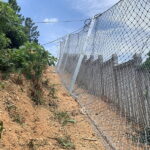
Passive Slope Protection Mesh
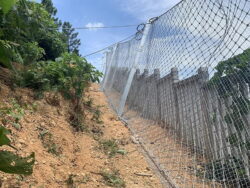
Passive Slope Rockfall Barrier | 500–2000kJ Complete Protection SystemPassive slope protection mesh are full interception systems set at slope toes to catch falling rock masses, distinct from surface-mounted active slope mesh. Each complete system includes galvanized steel posts, ring nets or wire rope panels, support ropes, energy dissipating brake rings, and anchoring fittings. Standard engineering energy ratings range from 250kJ to 2000kJ; common barrier heights are 2–6m with 8/10mm wire rope nets and 12–20mm support ropes. Layout, post spacing and anchor schemes are fully determined by rockfall calculation reports. Widely deployed along mountain highways, railway cuttings, tunnel portals and open mine slopes, all configurations are tailored to site terrain.
Passive Slope Protection Mesh is a rockfall barrier system installed at the slope toe, road side, or across a known rockfall path. It is used to intercept falling stones after they separate from the slope surface. A complete system normally includes steel posts, ring net or wire rope net panels, upper and lower support ropes, anchors, base plates, brake devices, and connection hardware. It is different from active slope mesh, which lies close to the slope face. For Passive Slope Protection Mesh, the barrier height, energy rating, post spacing, anchor type, and foundation details should be confirmed from the rockfall design report before production.
Specifications
System Type: Passive rockfall barrier system for slope toe or rockfall path installation.
Main Mesh: Ring net panel, steel wire rope net, or rope net with secondary double-twisted mesh.
Energy Rating: Common project ratings include 250kJ, 500kJ, 750kJ, 1000kJ, 1500kJ, and 2000kJ. Higher ratings are made by tested system design.
Barrier Height: Common heights are 2m, 3m, 4m, 5m, and 6m.
Post Type: Hot-dip galvanized steel post, H-section post, I-section post, or steel pipe post according to barrier design.
Post Spacing: Usually 5m to 10m. Final spacing depends on energy class, height, terrain, and drawing.
Support Rope Diameter: Common diameters are 12mm, 14mm, 16mm, 18mm, and 20mm.
Wire Rope Net Diameter: 8mm and 10mm galvanized steel wire rope are commonly used.
Ring Net Structure: Ring diameter and wire bundle count depend on the tested energy class.
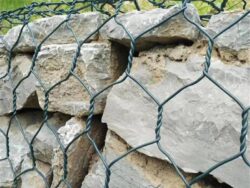
Secondary Mesh: Double-twisted hexagonal mesh or chain link mesh can be added to retain smaller stones.
Surface Treatment: Hot-dip galvanized steel is common. Zinc-aluminum alloy coating can be used for higher corrosion exposure.
Energy Dissipating Device: Brake rings, friction brakes, or deformation elements are selected by system design.
Anchors: Rock anchors, cable anchors, ground anchors, or concrete foundation anchors are used according to site condition.
Accessories: Shackles, wire rope clips, U-bolts, base plates, anchor plates, sewing rope, and connection rings.